Crop progress before the rain

With our area escaping the rain experienced during the September 24 to 30 period covered by the latest Crop Report from Saskatchewan Agriculture, we continued to be ahead of the rest of the province in harvest progress.

West-Central Saskatchewan (Crop Districts 6B – Hanley, Outlook, Loreburn, Saskatoon and Arelee areas; Crop District 7 – Rosetown, Kindersley, Eston, Major, Kerrobert, Macklin, Wilkie and Biggar areas)

The west-central region is the most advanced area of the province,  with 95 per cent of the crop combined and four per cent swathed or ready to straight-cut. Crop districts 7A and 7B recorded very little rain and so combines continued to roll in those areas. Rain ranged from nil to 62 mm (Hanley area). Spring wheat combined ranges from 90 to 100 per cent; oats 50 to 100 per cent; barley 40 100 per cent; canola 80 to 100 per cent and flax 10 to 100 per cent combined. Flax and canaryseed crops are being combined. Many farmers have completed harvest and others hope to finish within the week.

With some areas receiving very little rain, topsoil moisture conditions continue to deteriorate and are rated as 16 per cent adequate, 37 per cent short and 47 per cent very short on cropland. Hay land and pasture topsoil moisture conditions are rated as 22 per cent adequate, 30 per cent short and 48 per cent very short. Many areas in the region have not received a significant rainfall in over a month. Crop districts 7A and 7B are reporting over 40 per cent of the cropland, hay land and pasture is very short of topsoil moisture. Crop and combine fires have been reported in many areas.

Pasture conditions are rated as three per cent excellent, 13 per cent good, 43 per cent fair, 28 per cent poor and 13 per cent very poor.

The majority of the crop damage was caused by strong winds (of up to 80 km per /hour) that damaged some swathed crops. Producers are busy finishing harvest, working fields and starting fall weed control.

Provincially

Seventy-nine per cent of the 2013 crop is now combined, according to Saskatchewan Agriculture’s weekly Crop Report. Significant rainfall recorded last week slowed harvest progress in most areas of the province. Fifteen per cent is swathed or is ready to straight-cut. The five-year average (2008-2012) for this time of year is 74 per cent combined and 18 per cent swathed or ready to straight-cut.

Harvest progress is most advanced in the west-central region, where 95 per cent of the crop is combined. Seventy-two per cent is combined in the southeast; 85 per cent in the southwest; 68 per cent in the east-central region; 74 per cent in the northeast and 88 per cent in the northwest.

Rainfall throughout the province ranged from nil to 81 mm. Many areas received over 35 mm of rain, and heavy precipitation was reported in the southwestern, east-central and northeastern regions. Many areas in the southwestern, southeastern and east-central regions have been experiencing rain delays for a couple of weeks.

Across the province, topsoil moisture on cropland is rated as five per cent surplus, 65 per cent adequate, 19 per cent short and 11 per cent very short. Topsoil moisture on hay and pasture land is rated as two per cent surplus, 63 per cent adequate, 24 per cent short and 11 per cent very short.

Pasture conditions are rated as nine per cent excellent, 43 per cent good, 29 per cent fair, 16 per cent poor and three per cent very poor.

Rain and strong winds caused the majority of the crop damage. The rain has resulted in bleaching and sprouting of some cereal crops. Wind has caused some shattering losses in swathed canola and ripe crops.

Farmers are busy combining, hauling bales and completing fall weed control operations.
 

Sgt. Rusk explains Landis school closure

In a press conference held late in the morning of September 25, the day there was a “substantial” trail derailment just west of Landis, Saskatchewan, detachment commander of the Unity/Wilkie/Macklin RCMP, Sgt. Grant Rusk explained why Landis School was closed for the day.

http://www.youtube.com/watch?v=eunazchLeM0

For more information and photos of the derailment, see the Sept. 30 issue of the Unity-Wilkie Press-Herald.

Derailment photos in Monday’s paper

ttrain anker cars derailed

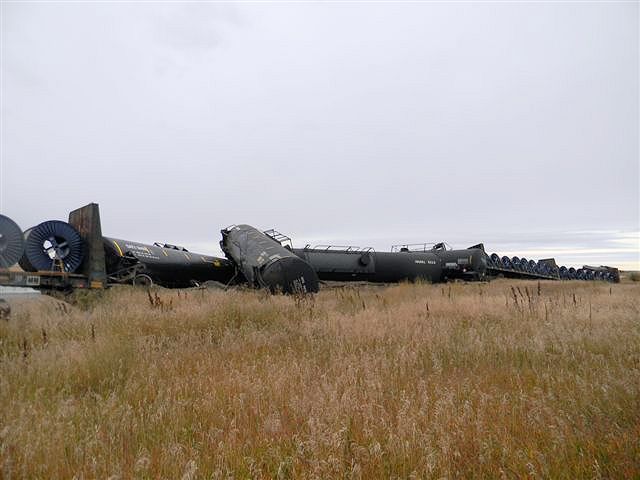
Tanker cars lay jumbled up after a number of cars, mid-train, derailed west of Landis September 25. Photo provided by Unity/Wilkie/Macklin RCMP.

With the “substantial” train derailment taking place near Landis September 25 being referred to in national media stories, the Unity-Wilkie Press-Herald is pleased to feature exclusive photos of the scene taken by its own correspondent, Alicia Leclercq, in Monday’s paper. See the September 30 issue for the story and pictures.

Also in Monday’s paper:

  • a report on moose-vehicle collisions
  • stories on the accomplishments of some of our 2013 grads
  • photos from Minor Football Day.

And don’t forget to check out the ads as there are a number of special events coming up!


Harvest progress most advanced in West Central Sask.

SASK. AG CROP REPORT FOR THE PERIOD SEPTEMBER 17 TO 23, 2013

Harvest is progressing well despite recent rains in many areas of the province.  Saskatchewan farmers now have 71 per cent of the 2013 crop combined, according to Saskatchewan Agriculture’s Weekly Crop Report.  Twenty-one per cent is swathed or ready to straight-cut.  The five-year average (2008-2012) for this time of year is 60 per cent combined and 23 per cent swathed or ready to straight-cut.

Harvest progress is most advanced in the west-central region, with 86 per cent of the crop combined.  Sixty-two per cent is combined in the southeast; 79 per cent in the southwest; 60 per cent in the east-central region; 68 per cent in the northeast and 73 per cent in the northwest.

Of the crop that has been harvested, average to above-average yields are being reported in most areas; however, they vary from region to region.  Spring wheat average yields are reported as 46 bushels per acre, durum 44 bushels per acre, barley 68 bushels per acre, canola 38 bushels per acre, and peas 43 bushels per acre.

harvest

If you look carefully, you can see a double rainbow in the sky above this harvested field. Taken September 23, 2013 in West Central Saskatchewan

West-Central Saskatchewan (Crop Districts 6B – Hanley, Outlook, Loreburn, Saskatoon and Arelee areas; Crop District 7 – Rosetown, Kindersley, Eston, Major, Kerrobert, Macklin, Wilkie and Biggar areas)

The west-central region is the most advanced area of the province with 86 per cent of the crop combined and 10 per cent swathed or ready to straight cut.  The five year average (2008-2012) for this time of year is 56 per cent combined.  Crop district 7A has 91 per cent combined, 6B 83 per cent combined and 7B has 84 per cent of the crop combined.  Little to no rain was received last week, helping farmers stay in the field.

Estimated yield ranges for the region are reported as follows: winter wheat 30 to 50 bu/ac, spring wheat 30 to 60 bu/ac, durum 37 to 60 bu/ac, oats 65 to 100 bu/ac, barley 50 to 80 bu/ac, fall rye 30 to 40 bu/ac, flax 25 to 35 bu/ac, canola 30 to 48 bu/ac, mustard 1000 to 2000 lb./ac, lentils 1200 to 2400 lb./ac, peas 30 to 60 bu/ac and canary seed 750 to 1500 lb./ac.  Overall, quality is good and many farmers are expecting to wrap up harvest in the next week or two.

Topsoil moisture conditions continue to deteriorate and are rated as 13 per cent adequate, 49 per cent short and 38 per cent very short on cropland. Hay land and pasture topsoil moisture conditions are rated as 14 per cent adequate, 44 per cent short and 42 per cent very short.  The region has not received significant rainfall in over a month and all crop districts are reporting that almost half of acres are short of topsoil moisture.

Crop and combine fires have been reported in many areas.

Producers are busy finishing harvest operations, working fields and starting fall weed control.

Stolen bicycles

bike stolen in Macklin


Unity/Macklin RCMP are investigating mischief to property and theft of bicycles which happened overnight around 2 to 3 a.m. on Saturday, September 21, between Times Street and Herald Street in Macklin. The suspects damaged park benches and other items in the park and then stole two BMX-style bicycles from the back yard of a residence.

One stolen bicycle is metallic blue with blue hand grips. The second BMX bicycle was white in colour with orange handlebars.

RCMP are processing evidence recovered from the scene.

Anyone with information is urged to contact RCMP at 306-228-6300 or Crime Stoppers at 1-800-222-TIPS (8477).

Next week’s paper

Your weekly sneak peek into the upcoming Unity-Wilkie Press-Herald:

  • perhaps you heard about the $1,000 random act of kindness in Luseland a couple of weeks ago? Now you can read all the details in Monday’s paper; along with
  • results and photos from the Candace Heitt Memorial Run;
  • a description of what goes on when court is held in Unity; and
  • a fun page of photos from Unity’s Fun Day of Golf.

Unity Fun Day of Golf

Unity Fun Day of Golf

Work rules for students

14- and 15-year-olds can only work 16 hours during a school week

Saskatchewan youth aged 14 and 15 must complete Saskatchewan’s Young Worker Readiness Certificate Course (YWRCC) and abide by Saskatchewan’s Minimum Age Employment laws if they want to work during the school year.

Employers are responsible for ensuring each young worker provides them with a YWRCC certificate, which must be kept on file. Employers must also follow the labour standards, occupational health and safety and minimum age employment laws.

“As school is a priority, it is important that youth with part-time jobs are aware of the minimum age laws,” Labour Relations and Workplace Safety Minister Don Morgan said. “There are limits on the hours per week they can work and the start and end times of their shifts.”

Young workers under the age of 16 must have the consent of their parent or guardian to work, are not allowed to work after 10 p.m. Sunday through Thursday, cannot work before school starts in the morning and cannot work more than 16 hours during a school week.

The YWRCC is a mandatory ready-for-work course that teaches youth about occupational health and safety, labour standards laws and their rights and duties as employees. Since 2010, more than 27,000 certificates have been printed.

The course can be taken online at www.lrws.gov.sk.ca/ywrcc. You can also learn more about YWRCC at 1-800-667-1783.

Fall fair and trade show coming up

With the Unity Agricultural Society’s annual fall fair and trade show coming up October
4 and 5, it’s time to start mounting those photos, finishing your sewing
projects and digging out the recipe books.

Ag society representative, Joan Sperle said, with some new prize sponsors, there are a few different things in the baking portion of the fall fair competition. In addition, organizers have added some categories to the preserves competitions to include items made with locally grown fruit.

Unity fall fair

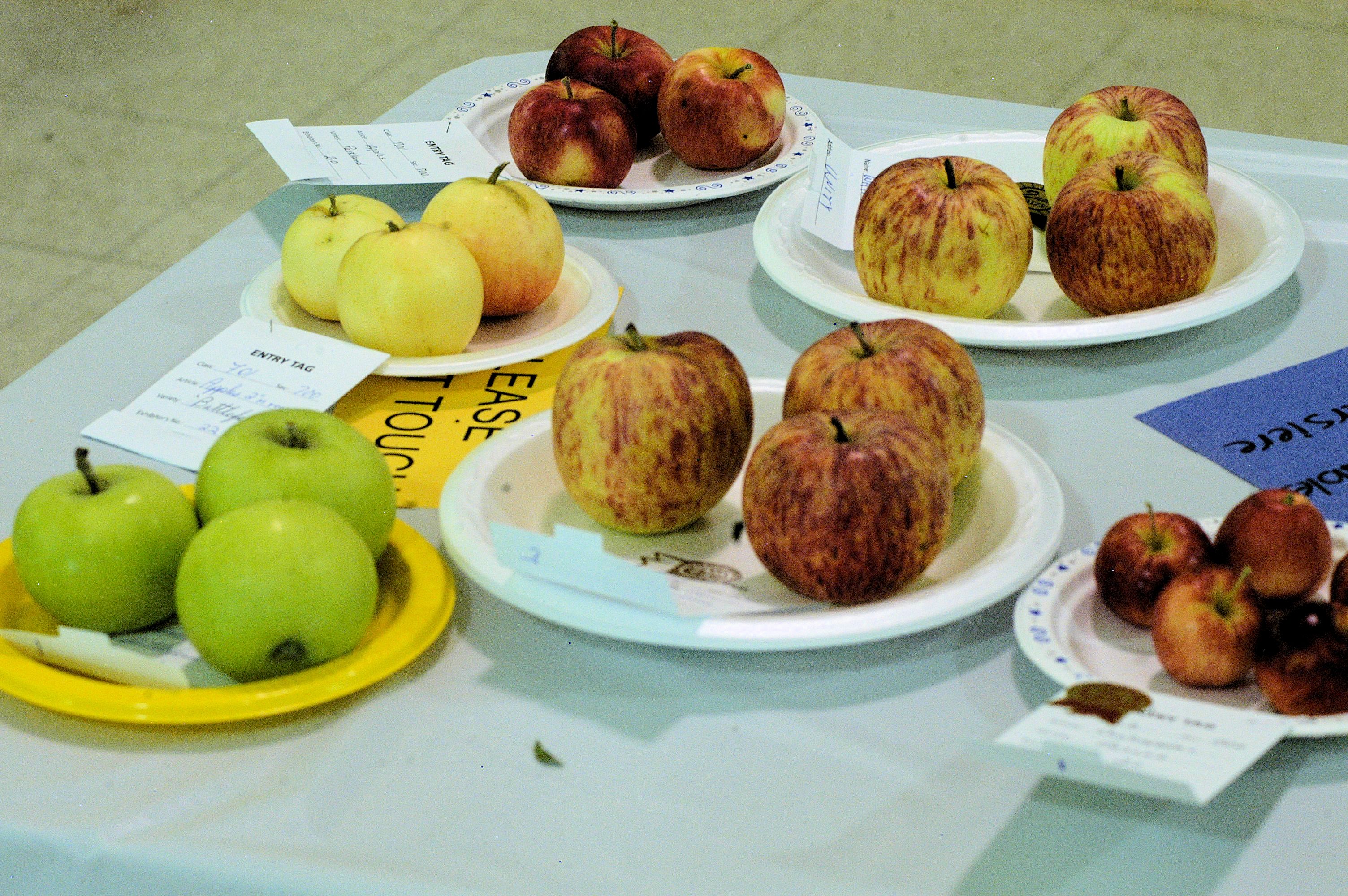
Locally grown apples arranged at the 2012 fall fair.

Fall fair books can be purchased for $1 at Mitchell Agencies. Mitchell Agencies also has tags available to identify your entries.

Joan said she would “like to see everybody participate.” President Elaine Sperle pointed out your projects don’t have to be perfect to be entered into the fall fair. You never know what could happen!

Elaine also wanted to remind everyone that if you have something you are working on, you can bring it just for display, to show it off to the community. You do not have to enter your item into a specific category for competition.

Delta Co-op and Unity Credit Union are partnering again to put on a silver donation pancake breakfast on Saturday, October 5. Proceeds will go to the Unity Food Bank. During the rest of the fair hours, 3 to 9 p.m. Friday and 9 to 4 p.m. Saturday, the ag society will operate their food booth.

Joan pointed out that, with admission still costing only $2, a visit to the Unity Fall Fair and Trade Show remains “pretty cheap entertainment for a couple of hours.”


The Letterheads

Fifteen sign makers, known as Letterheads, from as far afield as Georgia, Iowa and Ontario, gathered at Pat and Ruth Welter’s Masterhand Signs’ shop Aug. 29 to Sept. 2 to share their knowledge, experiment with new paints and let loose their creativity.

They created some art, learned some new things and had plenty of fun as you can see from this video.

http://www.youtube.com/watch?v=IgEh4QVhWqg&feature=em-upload_owner

One wall of the Masterhand Signs shop was covered with paper for painters to try out lettering styles before using them on an actual project. The painting on the right hand side was painted by Bruce Ander of Calgary, Alta., in memory of Ed Roth, a famous pinstriper and custom hot rod designer who created the Rat Fink character.

rat fink


Significant harvest progress

combine and grain truck

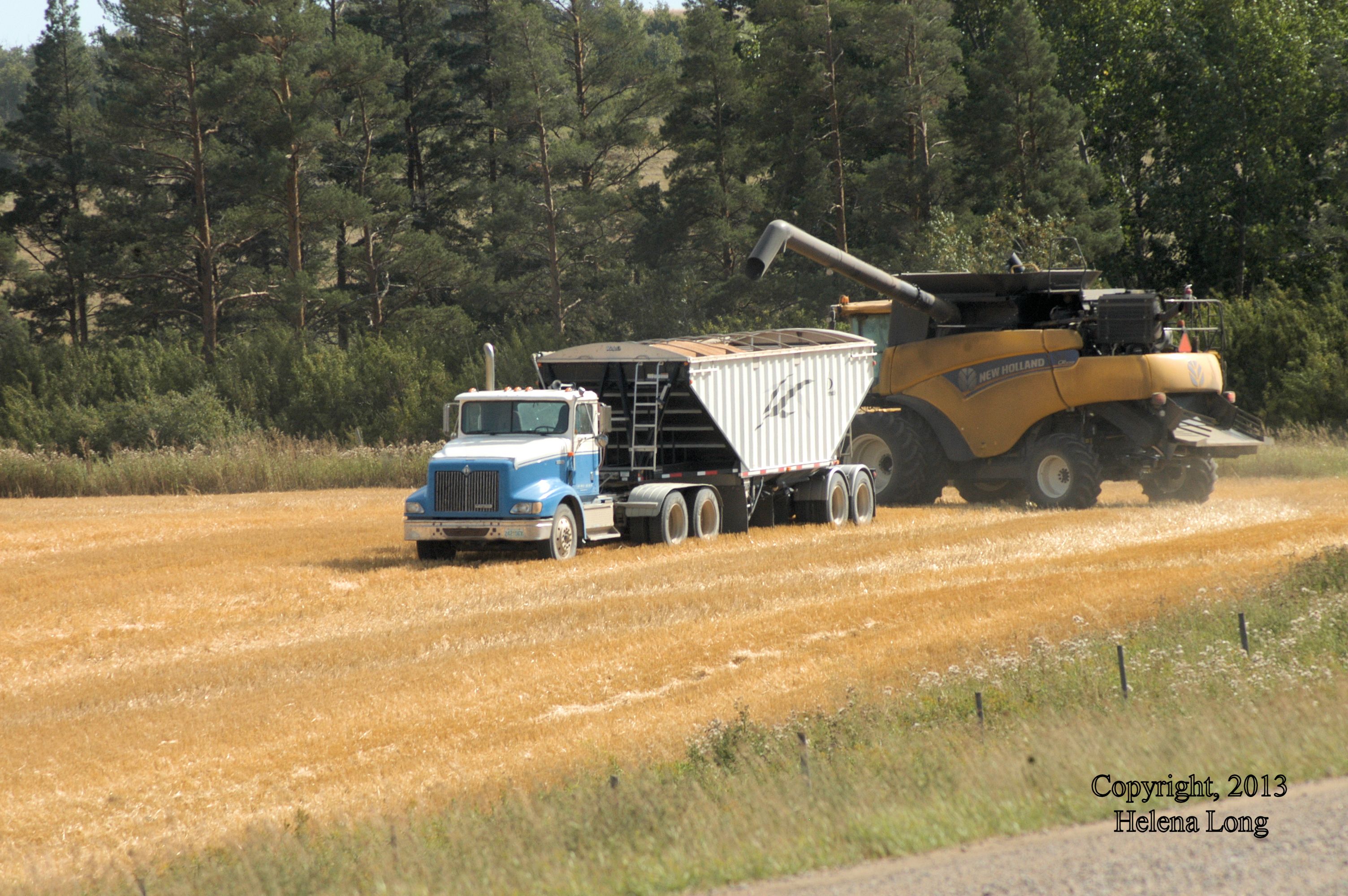
The combine rounds a grain truck on its way back to the field to pick up and process more golden swaths of canola.

The latest Saskatchewan Crop Report released by the Saskatchewan Ministry of Agriculture September 12, covering the week of September 3 to 9, reports great harvest progress and bounteous crops.

Province-wide, the report said:

Significant harvest progress was made this week, allowing Saskatchewan farmers to move ahead of the five-year harvest average. Thirty per cent of the 2013 provincial crop is combined and 36 per cent is swathed or ready to straight-cut, according to Saskatchewan Agriculture’s weekly Crop Report. The five-year average (2008-2012) for this time of year is 28 per cent combined and 31 per cent swathed or ready to straight-cut.

Harvest is most advanced in the southwestern region, where 46 per cent of the crop is combined. Twenty-eight per cent is combined in the southeast; 23 per cent in the east-central region; 38 per cent in the west-central region; 15 per cent in the northeast and 16 per cent in the northwest. Warm weather over the past few weeks has helped speed crop development.

Of the crop that has been harvested, above-average yields are being reported in most areas. Spring wheat average yields are reported as 43 bu/ac, barley 66 bu/ac, canola 35 bu/ac, lentils 1600 lb./ac and peas 42 bu/ac. Average yields vary from region to region, depending on seeding conditions and growing season moisture.

Thunderstorms later in the week dropped over 60 mm of rain in some parts of the south. Province-wide, the week’s rainfall ranged from nil to 86 mm. Grasshoppers, wind and heavy rains caused the majority of the reported crop damage.

Across the province, topsoil moisture on cropland is rated as three per cent surplus, 59 per cent adequate, 30 per cent short and eight per cent very short. Hay land and pasture topsoil moisture is rated as one per cent surplus, 54 per cent adequate, 35 per cent short and 10 per cent very short. Some areas in the western and central regions are very dry, affecting pasture productivity.

Farmers are busy desiccating, swathing and combining.

And in West-Central Saskatchewan:

Thirty-eight per cent of the 2013 crop is combined and 38 per cent is swathed or ready to straight-cut. Most areas recorded no rain during the week, allowing combines to keep moving in the field. Rainfall in the region ranged from nil to 8 mm (Craik area). Crop districts 6B and 7A have 41 per cent combined and Crop District 7B has 32 per cent combined. Crop reporters are indicating yields are well above average in most areas of the region.

Topsoil moisture conditions are rated as 31 per cent adequate, 46 per cent short and 23 per cent very short on cropland. Hay land and pasture topsoil moisture conditions are rated as 21 per cent adequate, 44 per cent short and 34 per cent very short. All crop districts in the region are reporting over half of the cropland and hay land is short of topsoil moisture. Crop District 6B is reporting 44 and 50 per cent of cropland and hay land and pasture, respectively, are very short of topsoil moisture. Soil conditions are very dry in the region, as most areas have not had a significant amount of rain for a month or more. Dry conditions have resulted in a few grass, stubble or combine fires.

Grasshopper populations are high, but very little damage was reported as most crops are into the maturity stages. Dry conditions are causing the majority of crop stress.  High winds in crop districts 7A and 7B caused some canola swaths to blow around. Producers are busy harvesting and hauling hay.